
- Elite Insights: Exploring High Stroke Rates in Top-Level Open Water Swimming
- The Stroke Rate Spectrum: Comparing Elite and Non-Elite Swimmers in Open Water”
- Research Meets Reality: How Increased Stroke Rates Can Enhance Your Swimming Performance
- Training Tools for Success: Using the Finis Tempo Trainer to Improve Your Stroke Rate
- Efficiency and Speed: Mastering the Art of High Stroke Rate in Open Water Races
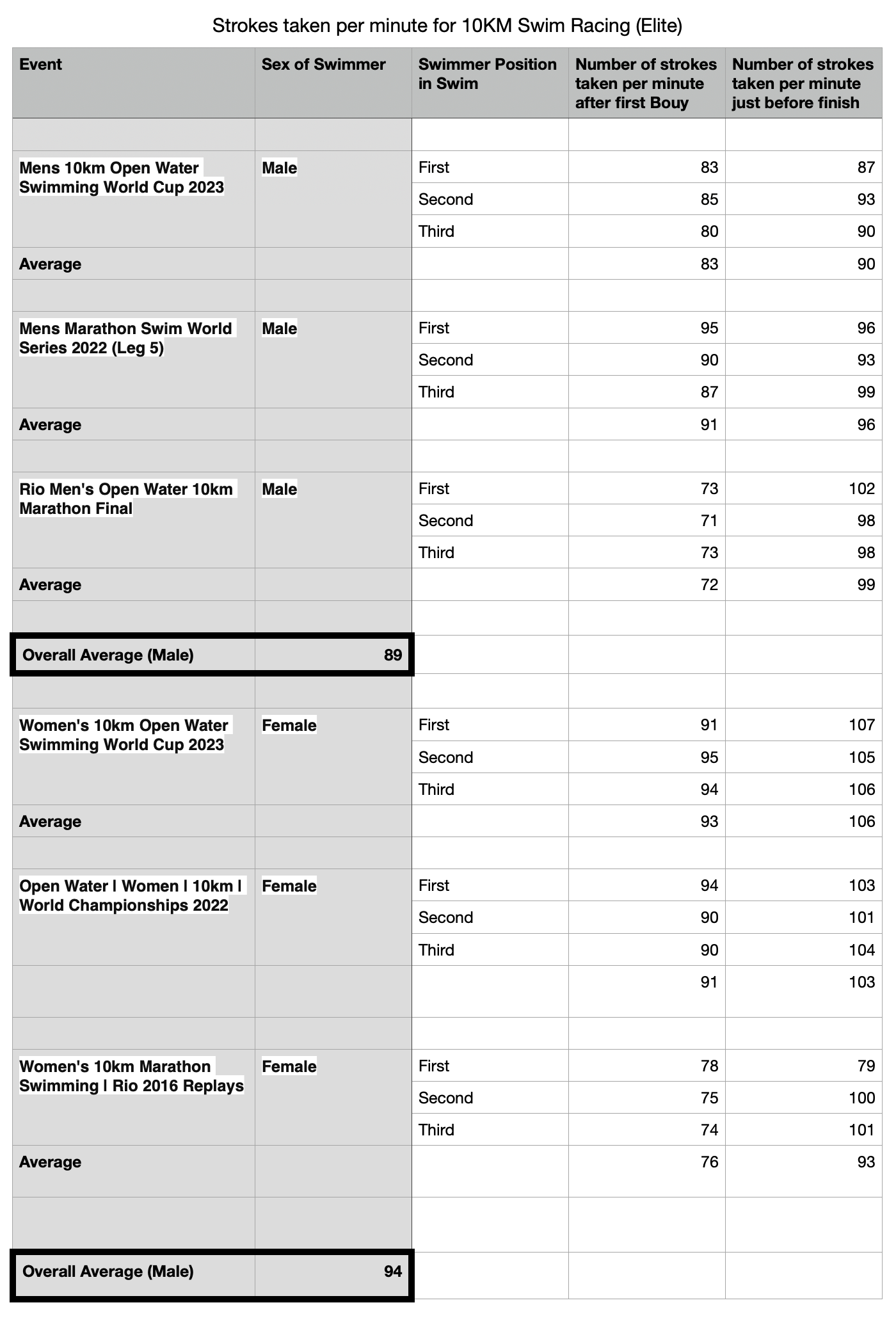
In the world of competitive swimming, particularly in the challenging arena of open water racing, one factor that often differentiates the elite from the rest is their stroke rate. As someone immersed in the world of swimming, both as a competitor and a coach, I’ve always been fascinated by the stark differences in stroke rates between elite and non-elite swimmers. This intrigue led me conduct analysis of elite open water races, examining the strokes per minute at pivotal race moments: the turn at the first buoy and the race’s conclusion. The findings, derived from detailed observations of Men’s and Women’s 10KM races, were enlightening and underscored the importance of stroke rate in swimming performance. (See table 1)
From academic research to firsthand race experiences, the evidence is clear: a higher stroke rate is often a hallmark of top performers. Studies, such as those conducted by López-Belmonte et al. (2023), highlight a positive correlation between stroke rate and swimming efficiency, particularly in high-intensity scenarios like open water races. This is not just theoretical; in the elite races I analysed, the top finishers maintained a stroke rate of approximately 80-85 strokes per minute after the first buoy, escalating impressively to 87-93 strokes per minute towards the race’s end.
Contrast this with the stroke rates observed in non-elite swimmers, typically ranging from 50-65 strokes per minute. The gap in stroke rates sheds light on the variations in physical conditioning, technique, and experience between different levels of swimmers. Elite swimmers excel in maintaining a high stroke rate efficiently, a challenging balance that less experienced swimmers often find difficult to achieve.
But why does a high stroke rate matter so much, especially in open water swimming? The answer lies in the physics of swimming: a higher stroke rate translates to increased propulsion, driving swimmers forward at greater speeds. However, it’s crucial to couple this with efficient stroke technique to prevent early fatigue.
In the intricate balance of swimming performance, there’s a pivotal point where increasing stroke rate no longer equates to increased speed. This phenomenon, deeply rooted in the biomechanics of swimming, highlights a crucial aspect of stroke efficiency. As you push your stroke rate beyond an optimal threshold, a counterproductive phase begins where the quality and efficiency of each stroke starts to deteriorate. This is often referred to as the “breakdown” of the stroke. When a swimmer’s stroke rate exceeds their individual biomechanical and physiological limits, the stroke becomes less effective. The once smooth and synchronised movements turn into rushed and shortened cycles. This not only leads to increased drag but also heightens the risk of fatigue. You start expending more energy with diminishing returns in terms of forward propulsion. Therefore, finding the sweet spot – a stroke rate that maximises speed without compromising stroke efficiency – is crucial. It’s a delicate balance, one that requires a good understanding of one’s capabilities and limitations, and is often the distinguishing factor between good and great swimmers.
This is where training tools like the Finis Tempo Trainer come into play. This device, which can be attached to a swim cap or goggles, beeps at set intervals, guiding swimmers to synchronise their strokes with these cues. Over time, this helps develop an internal rhythm, enhancing the swimmer’s ability to adjust their stroke rate instinctively during a race.
Regular training with devices like the Tempo Trainer can dramatically improve a swimmer’s capacity to sustain higher stroke rates over longer distances, mirroring open water race conditions. It’s a blend of swimming faster and smarter, focusing on both the physical and technical aspects of swimming. (Note, I have no commercial relationship with Finis–I just use the tempo trainer because it works!)

The significance of a high stroke rate in open water swimming, especially at the elite level, is undeniable. By understanding its benefits and employing the right training tools and methods, swimmers can notably boost their performance in open water races. As a coach, emphasising this aspect in training can provide you with a substantial competitive edge, elevating your performance from merely participating to excelling in the open water.


Leave a comment