
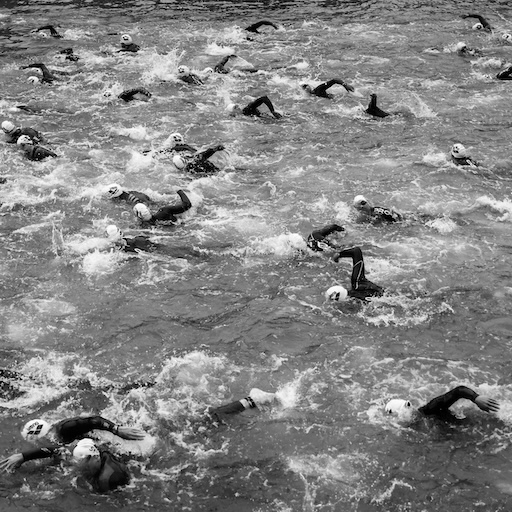
Here are the most critical points from the latest research insights on open-water swimming and how they can be applied in your training:
- Aerobic Capacity Dominates: A high aerobic power, or VO2 max, is crucial for sustaining endurance and speed over long distances in cold, open water environments.
- Lactate Thresholds as Pace Guides: Training near the first lactate threshold (LT1) improves the body’s ability to sustain steady pace for extended periods without fatigue.
- Critical Velocity (CV) Sets the Benchmark: CV is the fastest sustainable pace, guiding effective endurance training and performance prediction for long open-water swims.
- Integrate Pool Speed Work: Speed work in the pool enhances finish strength, crucial for sprinting through crowded finishes common in upcoming races like Pier to Perignon or Pier to Pub.
- Local Conditions Matter: Training in the colder, choppy waters of around Melbourne swimmers build resilience and adapt to race-day conditions.
I’m always on the lookout for research that sheds light on what it takes to excel in open water events, like the Pier to Perignon, Portsea Classic, or the iconic Pier to Pub. Whether you’re an elite-level competitor, a dedicated triathlete, or preparing for your next Ironman, understanding the science of swimming endurance can give you a real edge. A recent study published in Physiologia explores the physiological factors that help elite open-water swimmers perform at their best. Here’s a breakdown of what the research means for your training and performance, in plain language.
Why Aerobic Power is Crucial in Open Water
The study zeroes in on several key physiological markers, but let’s focus on one primary takeaway: aerobic power is absolutely essential for endurance swimming. Aerobic power refers to the body’s ability to deliver and use oxygen efficiently. In the world of swimming, this is often measured as VO2 max – the maximum volume of oxygen you can use while exercising intensely.
During a swim like the 10 km trials in this study, having a high aerobic power means you’re able to maintain faster speeds for longer without tiring. In Melbourne’s cold waters, having strong aerobic power also helps your body adapt to colder temperatures by boosting blood flow and muscle efficiency. This translates to more speed and less fatigue when you’re hitting the middle and end stages of a race.
What’s This About Lactate Thresholds?
The study measured lactate thresholds, which sound technical but are actually quite simple. As we swim, our bodies produce lactate as a byproduct of energy production. At moderate levels, our bodies can manage lactate without a problem. But when you push hard, lactate builds up quickly, and at a certain point – the lactate threshold (LT) – it starts to impact performance by causing fatigue.
The research looked at two specific thresholds:
1. LT1 (First Lactate Threshold) – where lactate begins to accumulate.
2. LT2 (Second Lactate Threshold) – a higher point where lactate accumulation is significant and fatigue sets in fast.
In the context of open water races, especially long distances, LT1 is particularly important. It represents a pace that you can hold for extended periods without tipping over into heavy fatigue. For longer events like Pier to Perignon, having a higher LT1 means you can sustain a strong, steady pace for the duration of the race. This can be a huge advantage in rough ocean conditions or against strong currents.
Critical Velocity: The Sweet Spot for Endurance Swimming
One of the key concepts explored in this study is Critical Velocity (CV). CV is essentially the fastest speed you can hold without fatiguing. For open-water swimmers, CV becomes a target zone – a speed that allows for efficiency, endurance, and enough reserve to push when needed.
The research suggests that CV can be calculated from pool times over various distances (200, 400, 800, and 1500m), and it closely correlates with open-water performance, particularly for distances like 10 km. For swimmers, knowing your CV can help guide your training by providing a benchmark pace for longer sets. If you’re aiming for Ironman or other endurance events, CV is invaluable as it identifies the pace you can likely sustain in open water over hours.
Practical Takeaways for Training
1. Train Around Your Aerobic Threshold (LT1): The study found that for longer swims, LT1 was a major performance marker. By training at or just below this threshold, you improve your body’s efficiency at clearing lactate, which is crucial for sustaining performance over time. In practice, this might mean longer interval sets or steady-state swims where you’re working at around 80-85% effort. A set like 5x1000m at a steady pace or 8x400m with a short rest interval can be highly effective.
2. Use Critical Velocity in Your Sets: Calculating and training at CV can help you target an ideal pace for endurance. For example, if you’ve established that your CV is 1:15/100m, work sets around this pace with minimal rest. This could look like 10x200m at CV with 15 seconds rest. It simulates the sustained effort you’ll need in a race, but with small breaks to maintain form and rhythm.
3. Incorporate Pool Speed Work for Race Day Finishes: Most open water events races involve sprinting at the finish. The research confirms that elite open-water swimmers excel in pool events, suggesting that adding speed work in the pool is beneficial even for distance swimmers. Sets like 8x100m or 6x50m at all-out pace with longer rest intervals help develop speed and sprinting ability for race-day finishes.
If you’ve read my previous post on “The Secret Pool Workout that Predicts Open Water Race Success”, you’ll recognise some common threads between this study and my approach. That post outlines pool-based workout techniques that can reliably predict race performance in open water, and this study provides the science that backs up why those pool workouts work so well. By focusing on lactate thresholds, critical velocity, and aerobic conditioning, my pool workouts set a foundation that pays off in any open water event.
Adapting to Melbourne’s Conditions
One thing the study doesn’t cover is Melbourne’s unique open-water conditions. Training for example in Port Phillip Bay, we contend with cold water, wind, and variable currents. For swimmers preparing for these events, it’s crucial to practice in similar conditions. Cold water training, in particular, builds resilience and ensures your aerobic engine is ready to perform even in challenging environments.
The Takeaway: Train Smart, Race Fast
This study underlines the importance of a well-rounded training program that builds aerobic capacity, targets lactate thresholds, and focuses on critical velocity. Whether you’re gearing up an endurance swimming event, understanding these principles can give you an edge. Melbourne’s waters present their own set of challenges, but by training with these physiological insights in mind, you’ll be better prepared to handle both the physical demands and the unpredictability of open water.
Take Your Training to the Next Level with AquaEdge
If you’re looking to integrate these cutting-edge training principles into your routine, consider joining my programs at AquaEdge. As an experienced coach dedicated to open-water performance, I offer personalised swim training designed to enhance your endurance, speed, and race-day readiness. Whether you’re preparing for a local event like the Pier to Pub or tackling longer challenges as a triathlete, my coaching focuses on techniques that boost both pool and open-water performance. Visit AquaEdge.com.au to explore the full range of services or book a session to see how we can elevate your open-water success together..
Absolute Beginner?
We have you sorted.
Have you always dreamt of gliding through open waters but felt held back by nerves? Or are you an aspiring triathlete excelling in running and cycling but hesitant about the swim? At AquaEdge, we specialise in transforming apprehension into achievement. Our experienced coach creates a nurturing and safe environment, perfect for beginners and first-time triathletes. We’re not just about teaching you to swim; we’re about instilling confidence, building skills, and turning your aquatic aspirations into reality. Join us for a completely obligation free 15 minute open water swim assessment.
 AquaEdge Swim Academy
Leave a comment