
Open Water Swimming
Free articleIf You're Swimming Alone, You're Doing It Wrong
The Art and Science of drafting
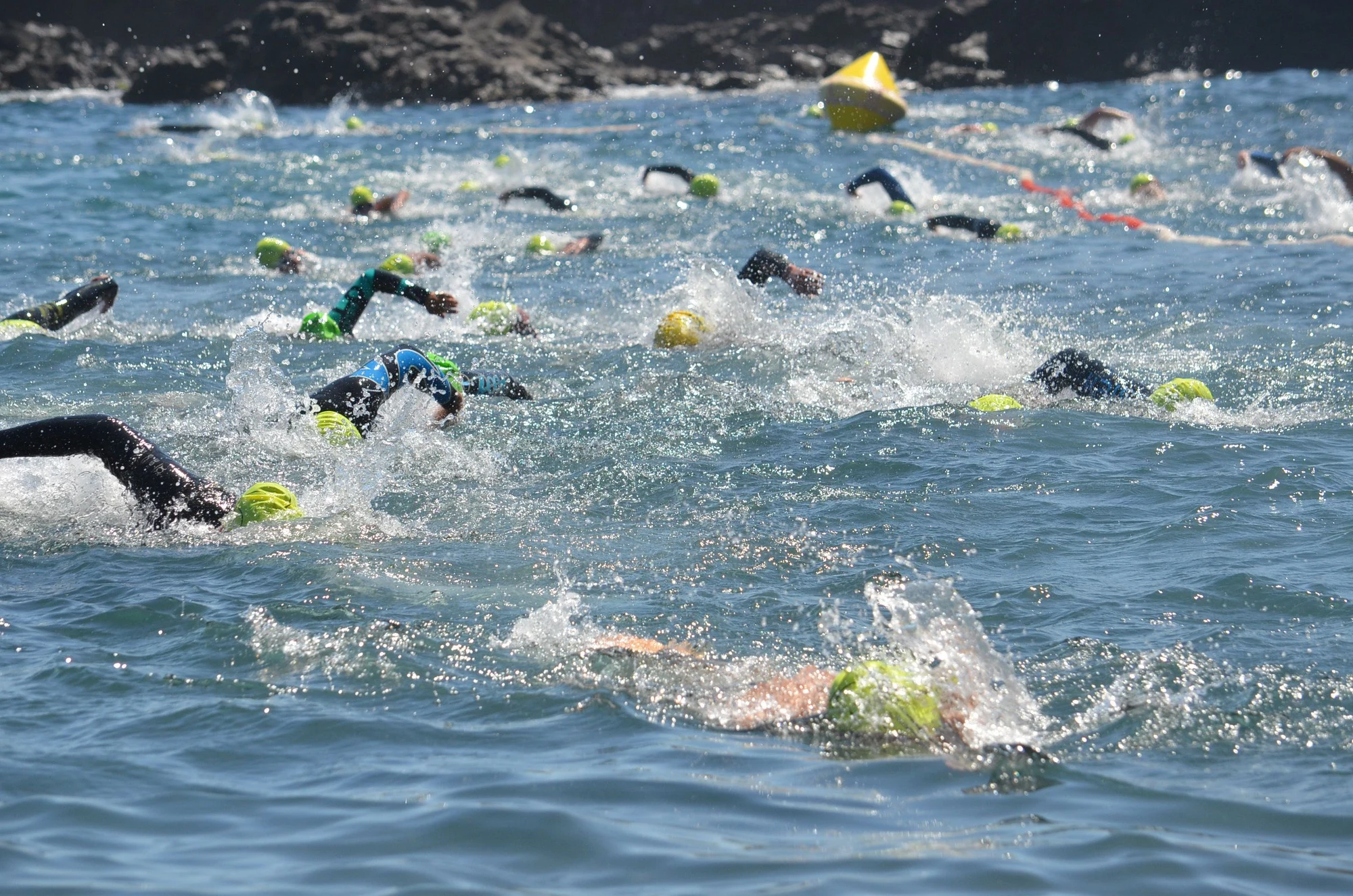
When it comes to competing in an open-water race, I don't want to be swimming alone. If there's another swimmer or a pack moving at a suitable pace, I'd much rather be following them and taking advantage of the huge energy savings that drafting offers. It's one of the most useful tactics available to open-water swimmers, yet I still come across the misconception that drafting is somehow against the rules.
In fact, drafting is perfectly legal in open-water competition under World Aquatics rules. Following another swimmer and benefiting from their wake is an accepted, and I would even say non-negotiable, part of racing. What the rules prohibit is deliberately obstructing or interfering with another swimmer, which is quite different from swimming in their draft.[2,3]
Of course, like most commentary on swimming, this statement needs some qualification. Put simply, this is because not every swimmer is worth following. A pack might be moving too quickly, taking a poor line or simply heading in a direction you don't want to go: there are also occasions when swimming independently makes more sense. But given the potential benefits of drafting, there there must always be good reason to choose to swim alone when a better alternative is available.
My approach to drafting has also evolved as I've got older. These days, I'm less able to maintain the early pace of younger swimmers who establish themselves in the front pack. That is not at all to say that I don’t like to get away strongly, but now, I’m much more selective about where I spend my energy and choose carefully which swimmers I will try to follow. Over the course of a race, these decisions can make a massive difference, and I've developed a few strategies that help me make the most of the swimmers around me.
Why the confusion is understandable
I can’t trace the belief that drafting is illegal to a single origin. There are, however, a few reasons that may have led to this often held misconception.
Triathlon is one possible source. Many age-group triathlons prohibit drafting on the bike, and “drafting penalty” is familiar language in that setting. Could it be that this idea has made it’s way into a discussion about swimming without recognising that the rules are different?[4]
Pool etiquette may contribute too: I can understand someone associating drafting with the swimmer who leaves too soon, sits on their feet and keeps touching their toes. That is annoying behaviour, but the objection is to being crowded or repeatedly touched. It doesn’t necessarily logically follow that drafting another swimmer during a race is prohibited.
There is also a genuine restriction on outside assistance. The published World Aquatics-based Australian rules prohibit pacing or slipstreaming from escort craft and pacing by another person entering the water. That is different from choosing to follow someone already competing in the race.[2]
The practical point here is to distinguish the rules of the event from an opinion about what feels fair. I don’t regard a good drafting position as something I should feel guilty about using.
The science behind drafting
The benefits of drafting are well established, although the size of the advantage depends considerably on where a swimmer positions themselves relative to the person ahead.
One of the most important studies on the subject was published in 2003 by Jean-Claude Chatard and Barry Wilson (It’s old, but it’s still useful!). The paper, Drafting Distance in Swimming, showed how following another swimmer affected the physical effort required to maintain a given speed.[1]
The researchers tested eleven swimmers under controlled conditions, comparing swimming alone with drafting at different distances behind a lead swimmer. At the closest drafting distances, swimmers consumed approximately 11% less oxygen than when swimming alone at the same speed. Their heart rates were also lower, as were blood lactate concentrations and ratings of perceived exertion.
In separate experiments, the researchers measured the resistance experienced by swimmers being passively towed through the water. They found that following closely behind another swimmer could reduce passive drag by approximately 20–21%.[1]
Note: An 11% reduction in oxygen consumption does not mean an 11% improvement in swimming speed, nor does a 20% reduction in passive drag translate directly into a 20% energy saving. Still the findings demonstrate a substantial physiological and drag advantage.
Does it matter where you position yourself?
| Drafting position | Reduction in passive drag |
|---|---|
| Directly behind, 0 cm separation | Approximately 21% |
| Directly behind, 50 cm separation | Approximately 20% |
| Best lateral position tested | Approximately 6–7% |
Source: Chatard & Wilson (2003). Distances behind the lead swimmer were measured from the leader’s toes to the following swimmer’s fingertips.
The most effective positions in the study were directly behind the lead swimmer, with a separation of up to 50 cm. The researchers also recorded lower oxygen consumption at greater following distances, extending to 150 cm, even where reductions in passive drag were not statistically significant.[1]
There are limitations to applying these results directly to an ocean race. The experiments were conducted under controlled conditions and the leader was towed rather than actively swimming. In open water, a swimmer’s kick, stroke, direction and pace continually change the conditions behind them.
Even so, the implication for your own racing is useful. If you can hold a particular speed with less effort, you will have more freedom to manage the rest of the swim. You might settle into a sustainable rhythm, stay with a slightly faster group or recover before making an effort to move forward.
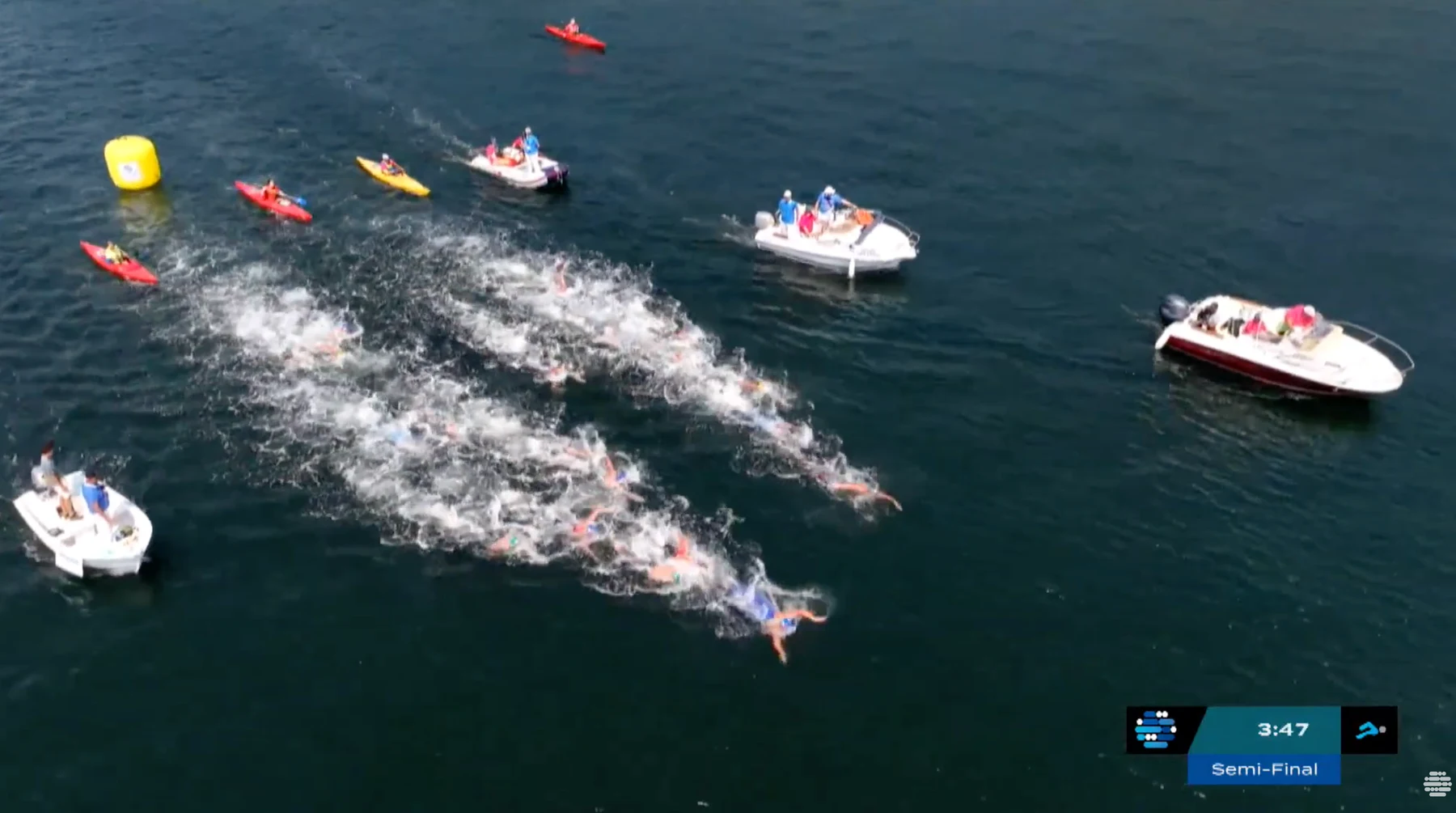
The challenge is applying that knowledge in a race where swimmers are moving around and the ideal position is not always available.
Putting drafting into practice
For me, drafting begins with finding a suitable group, and this is something I’m thinking about almost from the moment the race starts.
I generally try to get away strongly from the entry and maintain a good pace towards the first buoy. By this stage, the field has often begun to separate into distinct groups, making it easier to assess the swimmers around me.
Typically, there will be a small front pack, a second group following behind, and a much larger collection of swimmers further back. Within these groups, smaller clusters of perhaps four or five swimmers often emerge, travelling at similar speeds.
The pattern depends on the race format. An age-group start presents different opportunities from a mass start, such as the Pier to Perignon, where swimmers of widely varying ages and abilities enter the water together.
I’m looking for a group travelling at a pace that might be slightly faster than I could comfortably maintain on my own, but which becomes manageable with the assistance of drafting. There’s little point exhausting myself trying to reach a group that I won’t be able to stay with. Equally, settling into a group that’s much slower than I can swim might mean giving away time.
Once I’ve identified a suitable group (which takes practice and constant sighting), I then need to decide which swimmer to follow. Swimming speed is only one part of that decision.
Choosing someone who knows where they’re going
One of the first things I look for is a swimmer who appears to be navigating well. I watch how frequently they’re sighting, whether they’re maintaining a consistent direction and whether they seem to be following a reasonably direct course towards the next buoy.
Risk: Drafting can make you less attentive to your own (poor?) navigation. Once I’m concentrating on maintaining my position behind someone, it’s easy to reduce the frequency of my own sighting. There’s little advantage in saving effort by following a swimmer who is travelling further than necessary.
Consider a 2 km race in which a poor line adds another 100 metres. At a pace of 1:30 per 100 metres, that unnecessary distance adds 90 seconds. It could easily outweigh the benefit of an otherwise useful draft.
Of course, you can’t know with certainty that the swimmer ahead is navigating correctly. You still need to sight periodically and check the course yourself, particularly after turns or when swimming across a current. The ideal swimmer to follow is one travelling at a useful pace who also appears to be navigating accurately.
Where I like to position myself
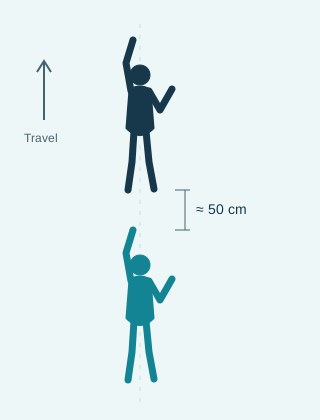
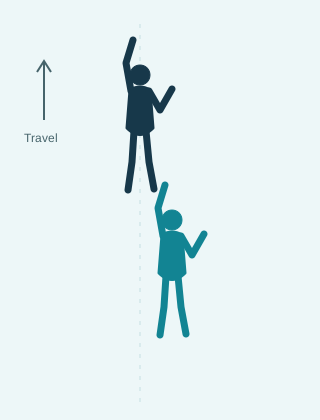
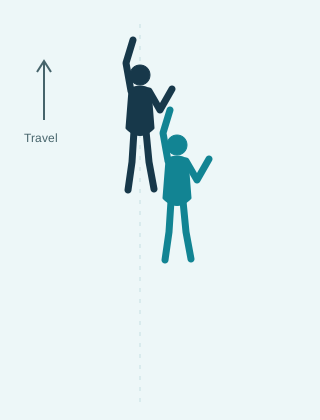
Once I’ve found a suitable swimmer, I generally try to position myself directly behind their feet or slightly to one side of their calves or ankles.
This preference for the latter position is partly about consideration for the swimmer ahead. I don’t particularly like repeatedly touching someone’s feet, and I don’t want to interfere with their stroke or kick. I also tend to avoid sitting very close alongside someone’s hip. Positioning myself just off the calves or ankles often feels like a comfortable compromise between obtaining a draft and giving the swimmer ahead some room.
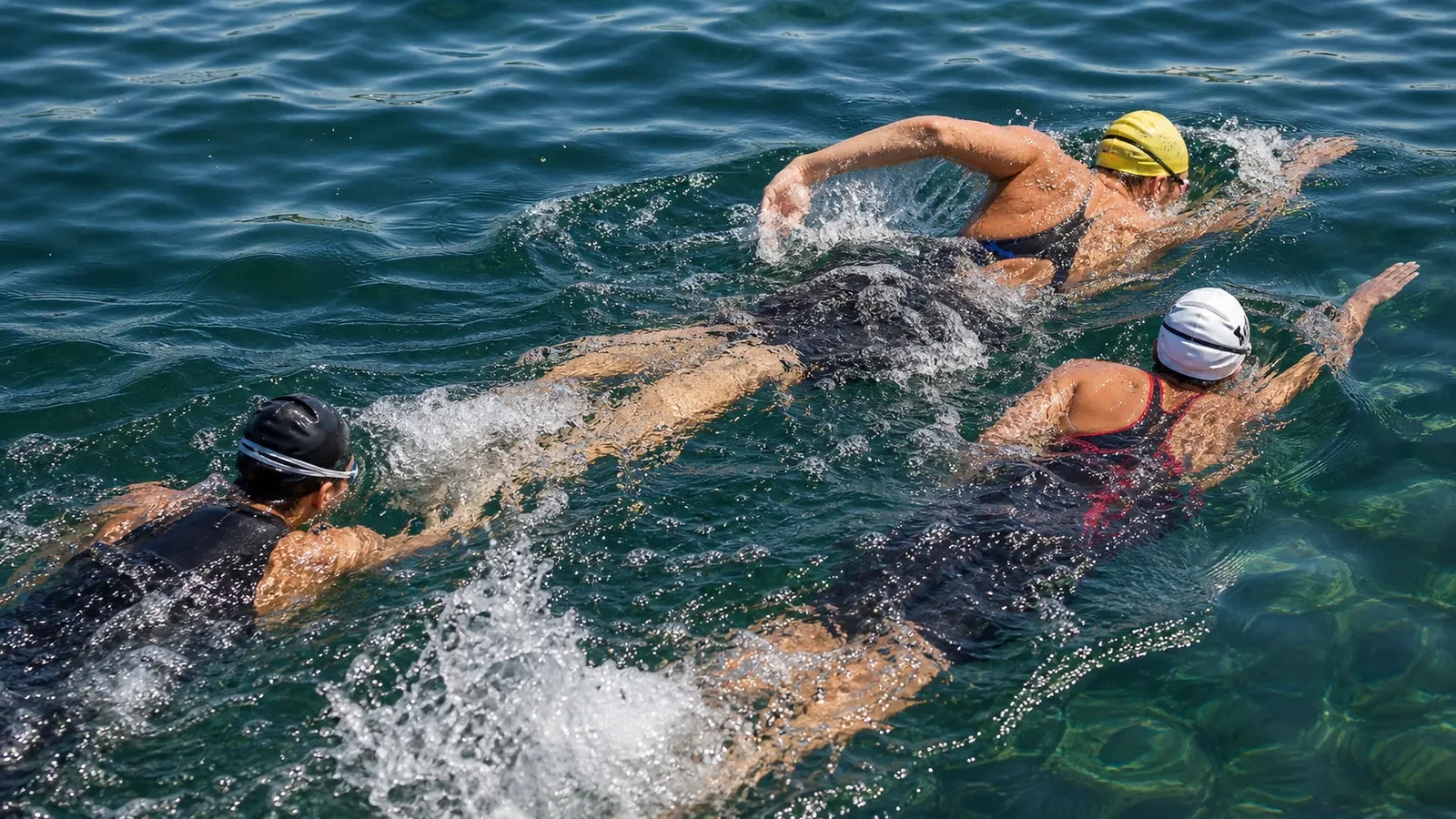
Looking again at the Chatard and Wilson research has made me reconsider whether that position is the most efficient. Their findings favour close, directly-behind drafting over the lateral positions they tested, although my particular position beside the calves was not measured.[1]
I’d like to compare those options in training. The best practical position may depend on the lead swimmer’s kick, the gap between us and how consistently I can maintain that position without contact.
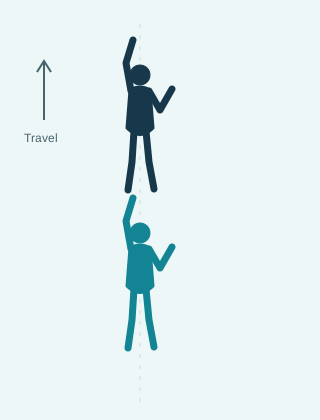
Drafting positions from above
Schematic illustrations, not photographs. Swimmer size is consistent across all four diagrams. Navy: leader. Aqua: follower. Arrows show travel. No performance benefit is assigned to the calf-side or hip illustrations.
Does the swimmer’s breathing side matter?
Another detail I pay attention to is which side the swimmer ahead breathes on. If someone consistently breathes to their left, I’ll sometimes position myself on their right, particularly when I’m following slightly behind their legs.
My reasoning is that I’m less likely to be noticed on their non-breathing side, and therefore less likely to distract or annoy them. It’s a preference I’ve developed through racing rather than a conclusion supported directly by the drafting research.
I can’t actually know whether they’ve noticed me, and it isn’t important to be invisible. I’m mainly looking for a position that allows both of us to swim without unnecessary contact. Their breathing side is another piece of information, but not something I’d prioritise over direction or a more effective position.
Using drafting to move through the field
On longer swims, I often use drafting to work my way forward. I’ll identify a faster swimmer ahead, make a short effort to reach them, then settle behind their feet or ankles and recover. Once I feel ready, I may look for another opportunity further ahead.
The paper did not test these repeated sprint–draft–recover moves.[1] They’re part of my own approach to racing, and whether they work depends on the gap, the effort required and how well the next swimmer suits me.
What I’m looking for after a move is somewhere I can settle. If I arrive and still have to work too hard to stay with the swimmer, I haven’t found the recovery opportunity I was expecting. Passing someone can feel like progress, but that doesn’t automatically mean it was a useful decision.
I’d rather bridge a manageable gap to a group I can stay with than keep making expensive efforts between individuals who are only slightly further ahead.
What I’d practise: a coach’s experience
I think drafting deserves practice rather than being left to race day. If you can get some fellow swimmers together, I’d begin with two swimmers holding a consistent pace, taking turns leading and following. The follower can compare a position directly behind the feet with one slightly offset near the calves.
I also ask my swimmers to notice whether they can maintain the position without repeatedly accelerating or making contact, and whether they’re still able to sight and check their direction. The leader’s feedback matters too. During these initial practice sessions, it becomes very apparent that swimmers who are first learning to draft will swim with excessive distance between them and their “draftee”. It takes repeated reminders to almost all the swimmers that they need to draft much closer than they think, otherwise they miss out on the benefits.
For my own swimming, I’m particularly interested in comparing my usual calf-side position with a more direct trailing position. I also want to be more selective about when I move between groups, rather than assuming every opportunity to pass another swimmer is worth taking.
I expect there will still be stretches in a race when I’m swimming alone. But when there’s a suitable swimmer or group within reach, I’d prefer that to be a deliberate choice rather than an opportunity I’ve overlooked.
Sources and rules notes
1. Chatard, J.-C., & Wilson, B. (2003). Drafting Distance in Swimming. Medicine & Science in Sports & Exercise, 35(7), 1176–1181. DOI: 10.1249/01.MSS.0000074564.06106.1F. Study on PubMed
2. Swimming Australia. Australian Open Water Swimming Rules, version 7, 11 January 2024. Rules PDF
3. British Swimming / Aquatics GB. Open Water Warning / Disqualification Report, revision 5, July 2023. Officials’ form
4. World Triathlon. Race-day FAQs: draft-legal and draft-illegal cycling formats. World Triathlon FAQ